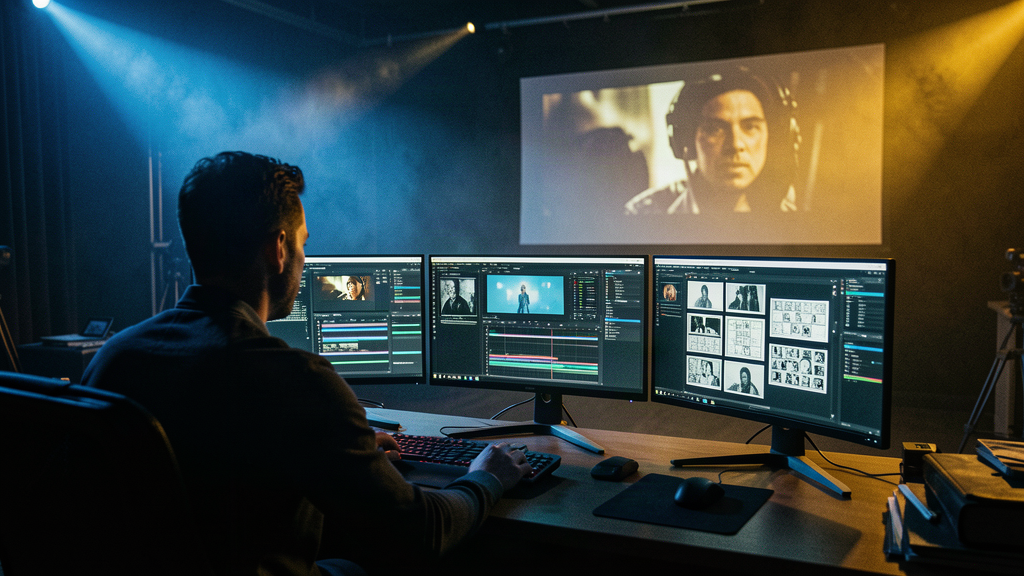
Stop picking one model. That's the fastest upgrade you can make to your AI film pipeline this month — and it costs nothing extra.
Every model has a ceiling. Seedance wins dialogue and character continuity. Kling wins action and physics. Veo wins premium polish. Runway wins the edit. The filmmakers shipping real work in 2026 — Fountain 0's 135-minute Odysseus: The Fall included — are routing scenes to the model that wins that specific job. Here's the scene-split pipeline, with the assignment table and the cost math.
The Assignment Table
Dialogue and character-continuity scenes → Seedance 2.0 / 2.5. Native lip-sync in 8+ languages — the mouth movements and the audio are generated together, so it reads as one piece of footage. Reference chaining is its superpower: the last frame of clip 1 becomes a reference for clip 2, and you can fix the spec upfront with up to 9 images, 3 video clips, and 3 audio files in one generation (Seedance 2.5 on Runway goes to 50 references). If the same character has to survive clip 1 through clip 40, this is your workhorse.
Action, motion, and physics-heavy scenes → Kling 3.0. Best-in-class natural human movement — hair, fabric, liquids, complex action sequences — with native 4K/60fps output and a 6-cut storyboard system that stitches into 60-second+ sequences. Independent tests across 80 identical prompts consistently rank Kling top for motion accuracy. Fountain 0 ran its entire feature on it. When things need to move hard and look right doing it, Kling takes the shot.
Hero shots and premium brand polish → Veo 3.1. Best color science and tonal range in the market — but it's the pricey one, roughly $2.50 per finished 10-second clip (about 5x Kling, 4x Seedance). Budget it for the 3-5 shots that open and close your film, not the 40 in the middle. Anything over 8 seconds requires chaining, which Veo handles less cleanly than Seedance — keep hero shots short.
Assembly, camera moves, and fixes → Runway. Motion Brush for surgical retargeting, real camera control, and editor integrations that plug into professional workflows. Runway is where scenes from different models get tamed into one timeline — and now it hosts all of them (Gen-4.5, Aleph, Kling 3.0, Veo 3.1, Seedance 2.0/2.5), so the split pipeline lives in one editor.
The Pipeline in 4 Steps
Step 1 — Lock the storyboard first. Generate a reference frame per character, costume, and key location before generating any motion. These references are what the split pipeline holds constant across models. Skip this and no model can save your continuity.
Step 2 — Route every scene by type. Dialogue → Seedance. Action → Kling. Hero/polish → Veo. Concept tests and variations → Kling's free tier (66 daily credits) before you spend anything.
Step 3 — Chain continuity across models. Feed each new generation the last frame of the previous clip plus your locked character refs. Seedance does this natively — use its reference chaining even for scenes you generate elsewhere, then pull the output into Runway.
Step 4 — Finish in Runway. Motion Brush fixes the fingers, the camera move gets an actual camera move, and the color grade happens in one place instead of across four export pipelines.
The Cost Math
A 30-scene short film routed by type: dialogue scenes in Seedance (credit plans from ~$9-18/mo), action scenes in Kling (paid from ~$6/mo, with the free daily tier absorbing tests), and 3 hero shots in Veo. Total cost per finished clip lands around $1.50-2.00 — versus $3-5+ when you force every scene through one premium model. The same pipeline that makes your film look better makes it cheaper.
"Seedance doesn't beat every model in every dimension. Sora wins where physics dominate. Kling wins where cost dominates. The filmmakers winning in 2026 are the ones who stopped asking which model is best and started asking which model is best for this scene."
— The AI Film Making Team
Want the workflow posts before they hit the archive? Subscribe to AI Film Making — it's free.